
Concrete Pumping Cost UK: How Much Does Concrete Pump Hire Cost in 2026?
Table of Contents
Ever watched while standing at the end of the driveway with a concrete wheelbarrow, wondering how you’ll get it round the back of the house before it hardens? The panic is the reason why so many people begin searching the web for concrete pumping for their project, as they find that they are at a deadlock. Wet concrete doesn’t wait around for anyone. Once it’s mixed, every minute counts, and your options shrink fast. A wide variety of additives and admixtures are incorporated into modern concrete for sustainable development, and the pumping behaviour of this modern concrete differs significantly from conventional concrete, especially at the fresh stage
Add to that the fact that pumping is widely used across the concrete industry because of its convenience and economy of placement compared with other methods, and you start to see why builders treat it as standard now, not some added extra.
The trouble is nobody tells you what it actually costs. You ring round three companies, get three different vague numbers, and end up more confused than when you started. We’ve watched clients stare blankly at a quote sheet that doesn’t explain a thing.
So this blog cuts straight through that mess.
How Much Does Concrete Pumping Cost in the UK?
Here’s the honest answer, and we won’t dress it up: there isn’t one fixed number. Concrete pump hire cost shifts from job to job, and anyone quoting you a flat figure without asking a single question about your site probably hasn’t looked at it properly yet.
What we can tell you is how the pricing actually works underneath it all. The cost of concrete pumping usually comes down to a handful of things:
- The type of pump needed (line pump or boom pump)
- How far the concrete has to travel from lorry to pour point
- How easy or hard the site is to get into
- How long the pump needs to sit parked up
- The overall size and scale of the pour
A small back-garden job using a line pump sits at the cheaper end, no surprise there. A large commercial pour using a boom pump, reaching across a busy site or over scaffolding, costs more. That’s not some trick to squeeze extra cash out of you. It reflects the machinery involved, the operator’s skill, and the time the whole job takes from start to finish.
What Affects Concrete Pumping Costs?
Think of it like booking a taxi. A short hop round the corner costs less than a slow crawl across town in rush hour. Concrete pumping rates work in much the same way. A few key things nudge the price up or down, sometimes more than you’d expect.
Distance and access. If the mixer lorry can pull up right next to your pour point, you’re already paying less. But if there’s a narrow side path, a fenced-in garden, or an upper floor involved, the pump works harder and longer, and that shows up in the final price.
Type of pump. A line pump is smaller and cheaper to run. A boom pump is a bigger machine with a mechanical arm built for reach and speed, so it naturally costs more to bring on site.
Time on site. The longer a pump sits waiting around, the more you pay. It really is that simple. A well-planned pour, with everything ready before the pump even turns up, keeps the final bill down.
Site conditions. Uneven ground, awkward turns, or tight parking all add extra time and hassle, and that hassle lands on your invoice one way or another.
No one wants to face an unforeseen expense after a project has been completed. That is why, of course, you should ask people to break it down in writing before you book it, so you won’t be sorry and regret it when it’s too late to argue.
Concrete Pump Rental: Line Pump vs Boom Pump
What is the cost to rent a line pump? Line pumps are compact, trailer-mounted pumps. They can push the concrete through flexible hoses, and that’s great if you want to pour in garden extensions, driveways, smaller residential pours, or other situations where it may get in tight spots. Generally, line pump rental is more affordable because it is easy to assemble upon arrival of the client and is compact. Then, they will do a substantially better job of handling their thicker mixes, such as screed, than a boom pump.
What is the price for hiring a boom pump? Boom pumps feature a long mechanical arm that is created to have multiple bends, extending over walls, fences, and obstacles, with precise real-time movements. They move a ton of concrete each hour, which is precisely what they are used for: warehouse floors, bridges and multi-storey constructions. The added reach and force it provides is more expensive because you are renting a larger, more powerful machine containing more parts and needing to service them more on the job site.
The right choice was never really about picking whatever’s cheapest on paper. It’s about matching the pump to the actual job in front of you, so you’re not paying for muscle you don’t need, and you’re not stuck with a machine too small to cope with the pour.
Is Concrete Pumping Worth the Cost?
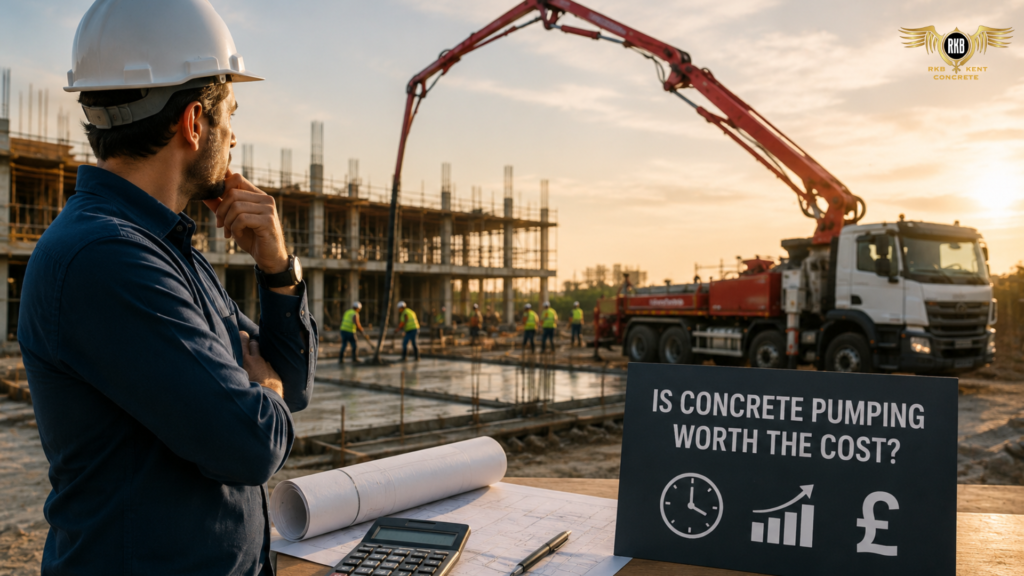
Picture the alternative for a second. A line of workers carrying heavy buckets and wheelbarrows across an uneven site, racing the clock before the mix starts stiffening on them. It’s slow. It’s tiring. And frankly, it’s risky when the site’s busy or the weather turns against you. Concrete pumping takes that whole headache off the table.
Here’s what you’re genuinely paying for when you hire a pump:
- Speed: the pour finishes quicker, which cuts labour time
- Cleanliness: far less mess and spillage, less clean-up once it’s done
- Access: pumps reach spots a wheelbarrow simply can’t get near
- Consistency: a steady, unbroken flow gives a smoother, stronger finish
For small, straightforward jobs, pouring by hand can still make sense; nothing wrong with that at all. But for anything large, awkward to reach, or squeezed by a tight deadline, pumping usually pays for itself through the labour hours saved and the waste avoided. Pumping is widely used on bigger projects because of the convenience and economy it brings to placement, and that same logic holds just as true for a home extension as it does for a full commercial build.
Hidden Costs People Forget to Ask About
This is the bit that catches out even experienced site managers, never mind first-time renovators. Beyond the headline concrete pump hire cost, a few extras can quietly turn up on the final invoice if nobody flags them early enough.
Waiting time is one. If your site isn’t ready the moment the pump arrives, you could be charged for the delay sitting there. Minimum hire charges are another; some contractors set a floor price even for short jobs, so a tiny pour might end up costing more per cubic metre than you’d expect walking in. Then there’s washout, cleaning the pump and pipes after use, which some firms fold into the price and others bill separately.
None of this needs to catch you off guard. Ask about it before you book, not after the invoice lands on your doormat, and it’s too late to push back.
How to Get a Fair Concrete Pumping Rate?
A little planning goes a long way here, and it costs nothing but a few minutes on the phone. Before you commit to any quote, make sure you:
- Ask for a full cost breakdown, not just one round figure
- Confirm exactly which pump type is being proposed, and why
- Check for minimum hire charges or waiting time fees upfront
- Ask about same-day or next-day availability if your timeline is tight
- Get access sorted and cleared before the pump even turns up
Doing this early stops nasty surprises landing weeks later. A contractor worth trusting walks you through all of this without you having to chase them down for straight answers.
Conclusion
We know concrete waits for nobody, and you shouldn’t have to wait around for a clear price either. If you’re weighing up your concrete pumping cost and want a straight answer instead of more guesswork, that’s exactly where RKB Kent Concrete comes in. Whether your job calls for a nimble line pump or a full boom pump for a bigger build, our team walks you through the pricing before you commit to a single thing.
We provide services across Kent, Dartford, Gravesend and the surrounding areas, with same-day and next-day slots available when your schedule is tight. Get in touch with RKB Kent Concrete today to book your concrete pump and get a free, no-obligation quote.
FAQs
1. How much does concrete pumping cost in the UK?
The price is not set and fixed. It depends on the type of pump, distance, site availability, and duration of the work, and a good quote always trumps a quick call guess.
2. How does the cost of concrete pumping vary?
The majority of factors are primarily the type of pump, distance to pour point, access difficulty to the site, and time spent on site.
3. Would it be worth the cost to include a concrete pump?
For most jobs, yes. It means reduced labour time, less mess, and a superior finish, particularly on larger or harder-to-reach pours.
4. The cost of the boom pump hire is how many times more expensive than a line pump?
Boom pumps are more expensive as they tend to be used for larger, more distant projects. Line pumps are smaller and better suited to tighter budgets and smaller residential sites.