
Table of Contents
Key Considerations Before Hiring a Concrete Pumping Company
Moving concrete across the area with a wheelbarrow becomes messy and tiring, especially when the area is wet and the path is uneven. That sinking feeling, the clock ticking, the mix stiffening by the second, is exactly why so many people start Googling a concrete pumping company at the worst possible moment. Wet concrete gives you no second chances. Once it’s mixed, every minute matters, and the wrong choice can cost you far more than money. This paper presents a comprehensive overview on the state of the art of concrete pumping. The models and methods used for characterizing the concrete pumpability and lubrication layer are described
Why Hiring the Right Concrete Pumping Company Actually Matters?
Picture this. You’ve booked a pour for Saturday morning. The lorry turns up. But the pump? Wrong size. Wrong reach. Wrong team standing about scratching their heads. Now you’re stood there, watching the hours tick past while the concrete starts going off in the drum, and nobody seems to have a straight answer.
This occurs more frequently than people think. Haste and hurriedness under stress will always come at a price, and in the long run. That’s the real risk of skipping the homework on your concrete pumping company before you sign anything at all.
Here’s the good news, though. It doesn’t have to go that way. A bit of groundwork now saves you a massive headache later on. Let’s break down exactly what to check before you commit.
1. Understand What You’re Actually Hiring: Concrete Pump Hire Explained
Before anything else, get your head around what concrete pump hire actually means for your project. You’re not just booking a machine and hoping for the best. You’re booking a method of getting wet concrete from the lorry to your exact pour point, quickly, cleanly, and without a small army of workers hauling buckets across the garden.
Concrete pumping is a fast, safe, and efficient process by which concrete is pumped to difficult access locations. It eliminates the need to wheelbarrow concrete to the site and expose it to drying conditions before it is first used. That one point alone should tell you why so many builders won’t touch a big pour without one.
- It saves time during the pour itself
- It reduces the physical labour needed on site
- It keeps the concrete workable right up until placement
- It reaches spots a wheelbarrow simply can’t manage
2. Ask: How Do I Choose a Concrete Pumping Company?
It’s the question that everyone should ask and yet so few people do. So, where do I find a concrete pumping company that will not disappoint halfway through the job?
Start by looking at experience. A company that’s been doing this for years knows how to read a site before they’ve even parked the lorry. They’ll spot the awkward gate, the soft patch of ground, the tight side passage, before it becomes a problem on the day.
Next, pay attention to how they talk to you on the phone. Do they ask about your site, your access, your timeline? Or do they just throw a number at you without a single question first? A proper concrete pumping company wants the details, because those details are exactly what decide the price and the plan.
- Check how long they’ve been operating in your area
- Ask if they inspect access before quoting a price
- See if they offer same-day or next-day slots
- Look for honest, upfront answers, not vague promises
3. Know the Difference Between Concrete Pumping Contractors
Not all concrete pumping contractors offer the same kit, and that matters more than most people expect. Some specialise in small residential jobs. Others are built for big commercial pours. Knowing which one you’re dealing with saves you from paying for muscle you don’t need, or getting stuck with a machine too small for the job.
Line pumps: These are compact, trailer-mounted units that push concrete through flexible hoses. They work brilliantly for garden extensions, driveways, and smaller residential pours where space is tight. They also handle thicker mixes, like screed, noticeably better than a boom pump does.
Boom pumps: They are equipped with a long mechanical arm, featuring several bends that allow them to move precisely over walls, fences, and other obstacles. They move hundreds of cubic metres of concrete an hour, hence their appearance on the warehouse floor, on bridges and multi-storey structures.
The right pick was never really about grabbing whichever looks cheaper on paper. It’s about matching the pump to the actual job sat in front of you.
4. What Should I Ask Before Hiring a Concrete Pump?
Here’s where most people trip up. They assume the quote covers everything, then get stung by extras nobody mentioned. So what should I ask before hiring a concrete pump, exactly?
Ask for a full written breakdown, not a rough figure over the phone. Confirm which pump type they’re proposing, and why. Check for minimum hire charges too, because some firms set a floor price even for tiny pours, which can make a small job cost more per cubic metre than expected.
- Is waiting time charged separately if my site isn’t ready?
- Does the quote include washout of the pump and pipes afterwards?
- What happens if access turns out harder than expected on the day?
- Can you confirm the pump size and reach in writing?
None of this needs to catch you out. Ask it upfront, not after the invoice lands on your doormat weeks later.
5. How Much Does Concrete Pump Hire Cost?
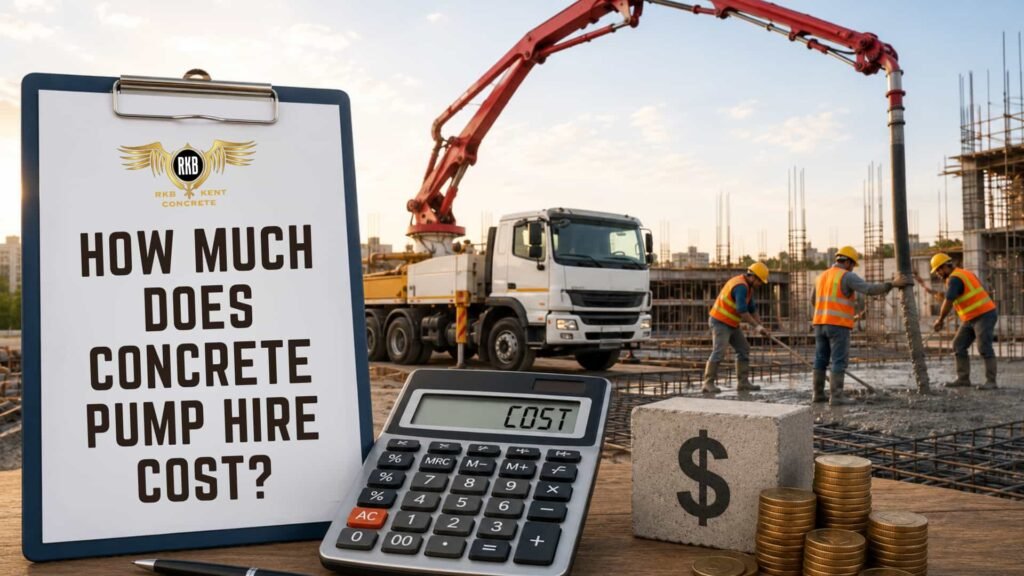
Let’s be honest about this one, because vague answers help nobody in the end. How much does concrete pump hire cost? There isn’t one flat number here, and anyone quoting you one without asking a single question about your site probably hasn’t looked at it properly.
The real cost usually comes down to a handful of things:
- The type of pump needed, line or boom
- How far the concrete travels from lorry to pour point
- How easy or hard the site is to access
- How long the pump sits parked up on site
- The overall scale of the pour itself
A small back-garden job with a line pump sits at the cheaper end, no surprise there. A large commercial pour with a boom pump, reaching over scaffolding on a busy site, costs considerably more. That’s not a trick to squeeze cash out of you. It reflects the machinery, the operator’s skill, and the time the whole job takes from start to finish.
6. Check Site Access Before You Book Anything
Think of it like booking a taxi. A short trip round the corner costs less than a slow crawl across town in traffic. Concrete pumping works much the same way. If the mixer lorry can park right next to your pour point, you’re already paying less.
But if there’s a narrow side path, a fenced garden, or an upper floor involved, the pump works harder and longer, and that shows up in your bill. Uneven ground, awkward turns, and tight parking all add extra time, and that time lands on the invoice.
7. Watch Out for Hidden Costs
This catches out even experienced site managers, never mind first-time renovators. Beyond the headline price, a few extras can quietly appear on the final invoice if nobody flags them early enough.
Waiting time is one culprit. If your site isn’t ready when the pump arrives, you could be charged for the delay. Minimum hire charges are another, since some firms set a floor cost even for short jobs. Then there’s washout, cleaning the pump and pipes after use, and some companies fold that into the price while others bill it separately.
8. Is Concrete Pumping Actually Worth It?
Picture the alternative for a moment. A line of workers carrying heavy buckets across uneven ground, racing the clock before the mix stiffens up on them. It’s slow. It’s tiring. And frankly, it’s risky when the site’s busy or the weather turns against you. Concrete pumping takes that whole headache off the table entirely.
Here’s what you’re genuinely paying for when you book a pump:
- Speed. The pour finishes quicker, cutting labour time significantly
- Cleanliness. Far less mess and spillage to clear up afterwards
- Access. Reaching spots a wheelbarrow simply can’t get near
- Consistency. A steady flow gives a smoother, stronger finish overall.
For tiny jobs, pouring by hand can still make sense; nothing wrong with that at all. But for anything large, awkward, or squeezed by a tight deadline, pumping usually pays for itself through the labour hours saved.
Conclusion
Right, so here’s the truth of it. Choosing a concrete pumping company isn’t about picking the first name that answers the phone fastest. It’s about asking the right questions, understanding what you’re actually paying for, and making sure your site is genuinely ready before that pump ever arrives. Get this right, and your pour goes smoothly, on time, with no nasty surprises waiting on the invoice.
If you’re based in Kent, Dartford, Gravesend, or the surrounding areas and want a concrete pumping company that actually explains things properly, RKB Kent Concrete is ready to help. Get in touch today for a free, no-obligation quote and book your concrete pump hire with a team that won’t leave you guessing. Visit rkbkentconcrete.co.uk to get started.
FAQs
1. How do I choose a concrete pumping company?
Look at their experience, how they assess your site before quoting, and whether they explain costs clearly from the start. A trustworthy company asks questions before giving you a number, not after.
2. What should I ask before hiring a concrete pump?
Ask for a written cost breakdown, confirm the pump type being used, check for minimum hire charges and waiting time fees, and clarify washout costs upfront before booking.
3. How much does concrete pump hire cost?
It depends on pump type, distance, site access, and time spent on site. There’s no fixed number, so always get a proper site-based quote rather than a rough guess over the phone.
4. What’s the difference between a line pump and a boom pump?
Line pumps are smaller, cheaper, and great for tight residential spaces. Boom pumps have a mechanical arm for reach and speed, better suited to larger or commercial pours.