

How to Check the Quality of Concrete Before Using It: 2026 Practical Guide for Builders
Table of Contents
Have you ever watched a freshly poured slab crack within weeks, and wondered if something was off long before the pour even started? That sick feeling in your stomach when the surface crumbles, splits, or just doesn’t look right is one every builder dreads. And the worst part? Most of those failures trace back to one thing nobody checked properly: concrete quality.
The truth is, poor-quality concrete doesn’t announce itself. It looks fine in the mixer. It pours just as smoothly. But over time, it lets you down, and by then, the damage is already done. In fact, research confirms that concrete hydration starts when water contacts with cement causing chemical reactions and increasing the concrete’s temperature. If the concrete is not cured and exposed to dry air it gets almost the 50% of the strength of cured concrete, if it is cured for 3 days it gets the 60-70%, but if it is cured for 7 days, it gets 80-90% of fully cured concrete strength. So the canon is that concrete should be covered for at least 7 days. So if you’re planning a build, big or small, this guide is the one you actually need to read before you pick up that phone and order.
Concrete Quality Checks Every Builder Must Know Before Pouring
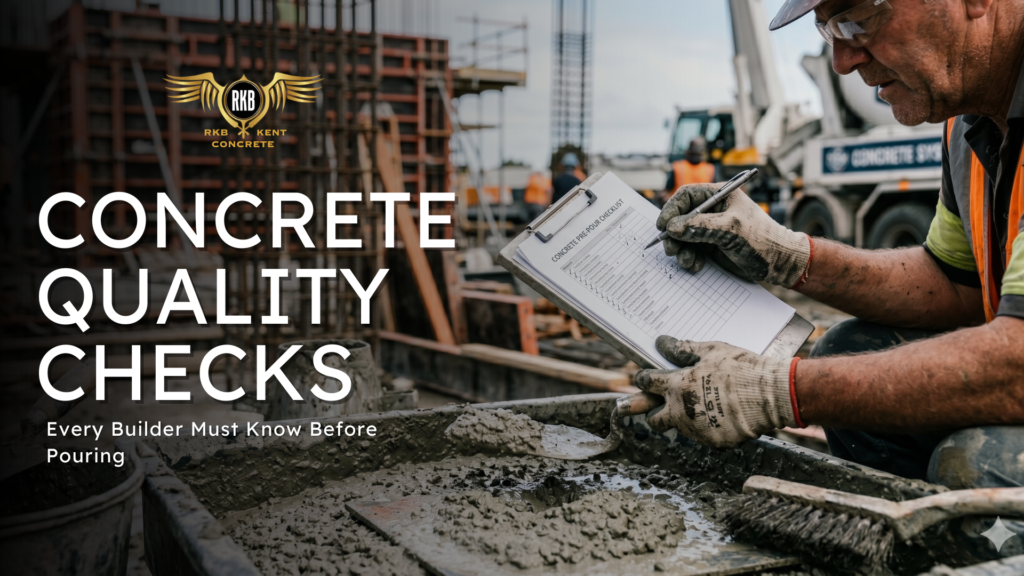
Let’s be honest. Most people don’t think about this until something goes wrong. We want to help you think about it before anything goes wrong. Here are the seven checks we’d tell any builder, whether you’re working on a garden slab or a full commercial foundation.
Check the Water-Cement Ratio First
This is the one that trips up the most people. Too much water and the mix weakens. Too little and it won’t bind properly. The water-cement ratio controls strength: it’s that simple.
- A ratio of around 0.4 to 0.5 is standard for most structural applications.
- If someone on site is adding water to “loosen” the mix, that’s a red flag. Every extra litre of water added beyond the mix design dilutes the strength.
- The best ready mix concrete for construction arrives with the water-cement ratio already dialled in, no adjusting on the fly.
With volumetric and ready mix concrete supplied under controlled plant conditions, this ratio is fixed before the truck even leaves. That’s one of the biggest advantages of ordering from a reliable supplier rather than mixing it yourself on site.
Do a Slump Test Before You Pour
The slump test is the quickest and most practical way to check workability on site. It tells you whether the concrete is too stiff, too wet, or just right for the job at hand.
- Fill a cone-shaped mould with concrete in three layers.
- Compact each layer, remove the cone, and measure how much the concrete drops.
- A slump of 75mm to 100mm is typical for general construction. Less than 25mm, and it’s too stiff. More than 150mm and something’s off.
Don’t skip this. It takes five minutes and saves hours of rework. If the slump result looks wrong, don’t pour; call your supplier and check the mix spec again.
Know Your Concrete Grade And Match It to the Job
Using the wrong grade is one of the most common and costly mistakes builders make. Not all concrete is created equal, and every application has a recommended strength rating.
Here’s a quick breakdown of concrete strength grades and their uses:
- C20 (20N): Domestic floors, shed and garage bases, single-storey foundations, patio sub-layers
- C25 (25N): Extensions, house foundations, mass concrete trench fill, drainage works
- C30 (30N): Driveways, paths, patios, pavements, shed and conservatory bases
- C40 (40N): Industrial slabs, structural applications, HGV parks, agricultural stores, traffic sign foundations
- C50 (50N): High-rise buildings, crane beams, motorways, special commercial structures
Concrete strength is measured 28 days after laying and curing. So choosing the right grade upfront is non-negotiable; you won’t know you’ve made the wrong call until it’s too late to change anything.
Inspect the Aggregates Visually
Aggregates, that’s the sand and gravel in the mix, play a bigger role in concrete quality than most people appreciate. Bad aggregates mean a weak, crumbly finish, even if everything else is done right.
When inspecting aggregates before or during the mix:
- Look for clean, hard, well-graded particles free from clay, dust, and organic matter.
- Avoid aggregates with excessive fines; they absorb more water and compromise strength.
- Consistent aggregate size across the mix is a sign of controlled production. Variable sizes suggest poor batching.
Premium-grade aggregate is a core part of what separates a quality ready mix concrete supplier from a cheap one. If the supplier can’t tell you what aggregates they’re using or where they source them from, that’s worth noting.
Watch the Colour and Consistency Carefully
Fresh concrete should look uniform: no patches, no segregation, no obvious clumps of dry cement. If you see:
- Grey blotches or dry lumps: the mix isn’t homogeneous. Poor mixing.
- Dark wet patches or watery bleed: excess water in the mix. Weakens the finished slab.
- A very pale, sandy appearance: possibly too much aggregate and not enough cement paste.
A well-produced batch will look consistent from the first pour to the last. If something looks off, don’t assume it’ll be fine once it cures. It won’t.
Run a Proper Concrete Estimation Before You Order
Ordering too little means you’re stuck with cold joints, those weak seams where old and new concrete meet. Ordering too much means paying for waste. Both are problems you want to avoid entirely.
Good concrete estimation starts with accurate measurements. Multiply the length × width × depth of the area you’re filling. That gives you your volume in cubic metres. From there, factor in a small contingency, typically 5% to 10%, for spillage and site variations.
If the numbers aren’t coming naturally, try our online volumetric calculator, which makes the whole process straightforward. You enter your dimensions and get an accurate figure without any mental arithmetic. Getting your concrete estimation right the first time means no delays, no emergency top-up orders, and no waste sitting in a drum at the end of the day.
Check Curing Conditions on Site
Good concrete can still fail if it cures badly. Curing is the period after pouring where the concrete hardens, and it needs the right temperature and moisture to do that properly.
- In cold weather, concrete can freeze before it reaches adequate strength. Protect it with insulated sheeting.
- In hot, dry weather, rapid evaporation causes surface cracking. Keep the surface damp or cover it with polythene during the first 24 to 72 hours.
- Foot traffic too early, even light pressure. can permanently damage the surface structure of a slab.
The concrete might look hard on the outside within a day or two. But full structural strength for most mixes isn’t reached until 28 days after pouring. Respect that timeline.
Conclusion
Poor concrete quality doesn’t just cost money. It costs time, trust, and sometimes safety. Whether you’re a self-builder tackling a driveway or a groundworker managing a commercial slab, these checks aren’t optional; they’re the difference between a build that lasts decades and one that starts showing cracks in months.
If you’re based in Kent and want to take the guesswork out of this entirely, RKB Kent Concrete Ltd. supplies premium-grade ready mix concrete across Gravesend, Dartford, and the wider Kent area, with same-day, next-day, and even night time delivery. As one of the most trusted ready mix concrete suppliers near me for builders across concrete Kent projects, they offer grades from C20 to C50, volumetric mixing, concrete pumping, screed, and a free online volumetric calculator to nail your concrete estimation before you order a single cube.
Whether you’re searching for ready mix concrete Gravesend, ready mix concrete Kent near me, or a reliable concrete supplier Dartford, one call to us puts quality concrete on your site. Get your free quote today by dialing us at +44 7956 409828.
FAQs
1. What is the most reliable way to test concrete quality on a construction site?
The slump test is the quickest field test. For more definitive strength data, cylinder or cube samples can be taken and tested in a lab at 7 and 28 days after pouring.
2. How do I know which concrete grade is right for my project?
Match the grade to the load and use case. C25 or C30 covers most domestic builds, extensions, and driveways. Commercial or heavy-duty applications typically need C40 or above. If you’re unsure, speak to your concrete supplier before ordering.
3. Can I add water to concrete if it seems too thick on site?
No. Adding extra water on site beyond the specified mix design weakens the concrete by increasing the water-cement ratio. If the workability isn’t right, raise it with your supplier.
4. How accurate does my concrete volume calculation need to be?
As accurately as possible. Our online volumetric calculator helps you get close, but always add a 5–10% buffer for site waste. Under-ordering is riskier than slight over-ordering, as cold joints between pours create structural weak points.
Disclaimer- The information provided in the content is for educational purposes only and is written by a professional writer. Contact us to learn more about concrete supply.
Citation: