
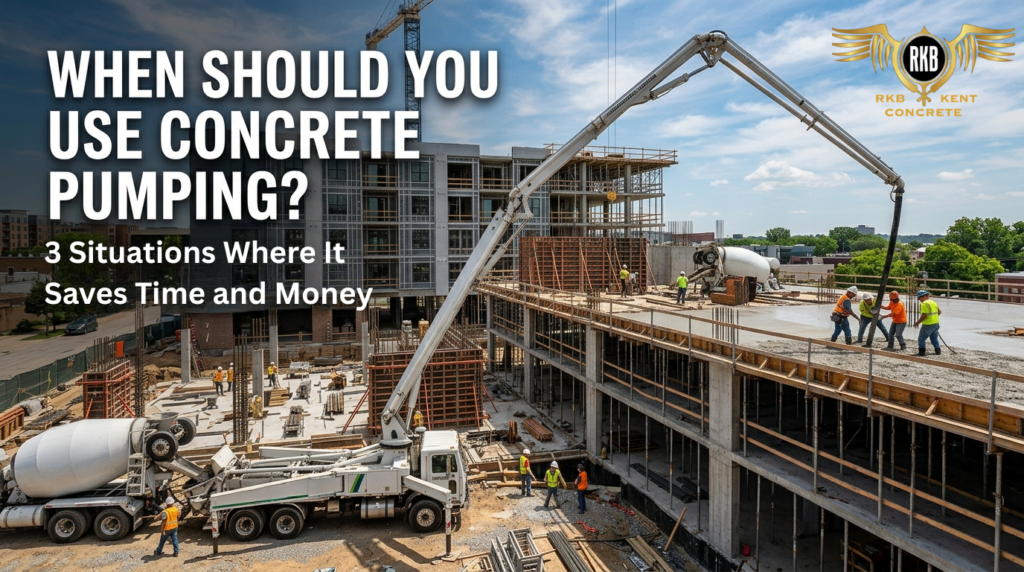
When Should You Use Concrete Pumping? 3 Situations Where It Saves Time and Money
Table of Contents
Once the concrete is mixed, every minute matters. Hence, moving concrete by hand with wheelbarrows will be time-consuming and may also affect the quality and strength of the final result. That small moment of panic is exactly why so many people start searching for when to use concrete pumping; halfway through a job that’s already gone a bit wrong. Using concrete pump, you can pour concrete to places which are difficult to reach. That’s why it has become the most preferred choice of builders.
A study published in Scientific Reports (Liao et al., 2023), available through ResearchGate, notes that concrete pumping is central to building construction and directly affects both pipeline durability and how efficiently the overall job runs. So that old worry about pumping “weakening” your concrete? Not backed by the evidence at all. This blog walks through exactly when pumping earns its cost, and when it doesn’t.
When Is Concrete Pumping Necessary?
Not every pour needs a pump. But there are moments when trying to manage without one turns a simple job into a stressful, expensive mess. Here’s how you know it’s time to book one.
- The concrete lorry can’t get close enough to where you’re actually pouring.
- The job is too big to finish by hand before the mix starts to go off.
- The site has narrow paths, fences, or steps that block wheelbarrow access.
- You need concrete on an upper floor, in a basement, or over a long distance.
- Speed matters because the weather is turning or the deadline is tight.
If all this sounds familiar, don’t be fussy about it. You’re being sensible. Prevent the mix from sitting around and drying out between wheelbarrow trips by pumping it in motion all the time. That one detail is often the whole difference between a smooth, even pour and a patchy one full of cold joints and regret later.
Situation 1: Difficult Access Sites
This is the classic headache. A narrow side return. A fenced-in back garden. A driveway tucked behind a locked gate that no lorry is ever getting near. You know exactly where the concrete needs to go, but there’s no obvious way to get it there without hours of backbreaking wheelbarrow runs across your own lawn.
This is where a concrete pump hire service changes the whole picture. Instead of hauling heavy loads by hand across uneven ground, the pump sends the mix straight through a pipe or hose to the exact spot you need it. No trampled flower beds. No exhausted crew standing around swearing under their breath. No concrete drying out halfway through because someone had to stop for a breather.
Line pumps are built for this exact job. They are smaller, medium-pressure units that force concrete to move through flexible hoses, and fit into small side gaps and inside small paths. They are ideal for garden extensions, driveways and lighter finishes such as screed, which the larger machines struggle to manage.
Real example: picture a homeowner replacing a driveway behind a locked side gate, with the mixer lorry stuck out on the road, unable to get any closer. A line pump reaches straight over the fence and down the path, filling the whole area in one steady, unbroken pour. What would have taken a full day of wheelbarrows gets finished before lunch.
Situation 2: Large or Time-Sensitive Pours
Big jobs come with big pressure. Foundation slabs, warehouse floors, large driveways, or multi-storey extensions all need a serious volume of concrete delivered quickly and evenly. Try doing that by hand, and you’re fighting the clock the entire time, because concrete keeps hardening whether your crew is ready for it or not.
This is where concrete pumping benefits really show up. A pump keeps the flow constant, which means:
- Faster overall pour times, even on large volume jobs.
- Fewer workers standing around waiting between loads.
- A consistent, smooth finish with no weak joints from delayed pouring.
- Less risk of the mix starting to set before the whole pour is finished.
Boom pumps are built exactly for this. Their mechanical arm is long and bends at multiple points, allowing them to reach clean from multiple storeys, walls and obstacles with true precision. They give you a ton of concrete per hour, which is why they’re the first option for warehouse floors, bridges and multi-story constructions.
Real example: think of a commercial site pouring a full warehouse floor slab in a single day, before the weather turns against them. A boom pump reaches every corner of the site from one fixed spot, keeping the mix flowing without a single break. The pour finishes on schedule, the surface cures evenly, and nobody has to come back later to patch weak spots.
Situation 3: Projects Needing a Clean, Efficient Site
Sometimes the problem isn’t access or size at all. It’s mess. Wheelbarrows spill. Manual handling leaves trails of dropped concrete across paths, lawns, and driveways that somebody then has to clean up on top of everything else already going on. On a working site, that lost time quietly adds up over the day.
Pumping solves this quietly but properly. Because the concrete travels through the pipe instead of being carried and tipped over and over, there’s far less spillage and far less mess left behind afterwards. That means:
- A tidier, safer site with much less slip and trip risk.
- Less time spent on post-pour cleanup at the end of the day.
- Lower physical strain on the crew, since there’s no repeated heavy lifting.
- A neater finish because the mix isn’t handled multiple times before it goes down.
Real example: a small extension project with a tight budget and a young family living right next door. Instead of a chaotic day of buckets and wheelbarrows trailing wet concrete across the garden, a pump delivers the mix directly and cleanly to the foundation trench. The site stays walkable, the neighbours stay unbothered, and the crew moves straight on to the next task that same afternoon.
Can Concrete Pumping Be Used for Driveways?
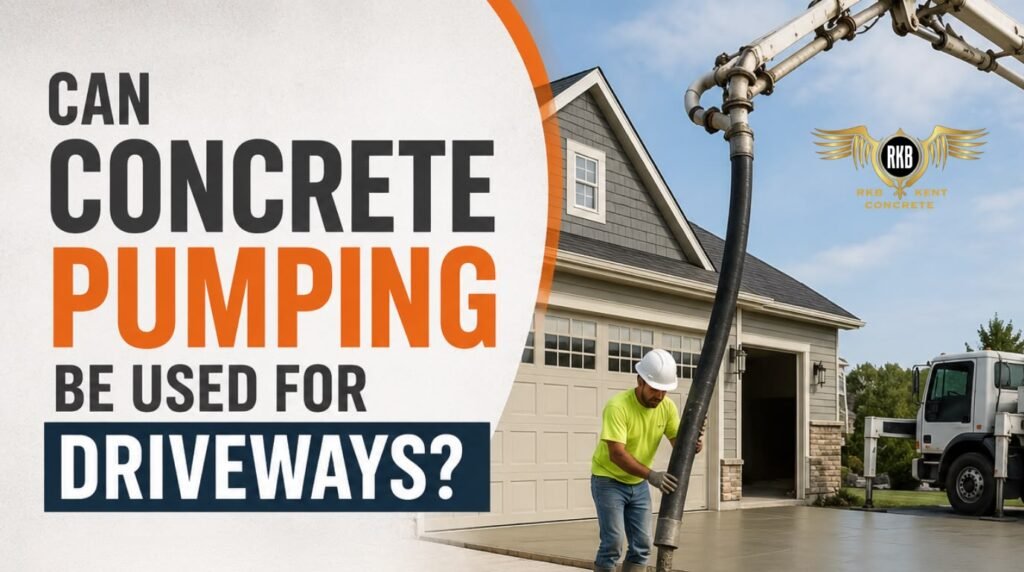
Yes, and it’s actually one of the most common domestic uses out there. Driveways are often long, sometimes curved, and frequently sit behind gates or narrow access points that a mixer lorry simply can’t get anywhere near. A line pump handles this comfortably, sending concrete directly to the area without ever needing the lorry to reach the pour point itself.
Is Concrete Pumping Suitable for Small Projects?
It can be, though it really depends on the specific job. For very small, easy access pours, pouring by hand might still make sense. But for anything with tricky access, like a fenced garden or a raised patio, even a modest-sized job benefits a lot from a line pump. It’s worth asking for advice before assuming pumping is too much for a smaller project, because the labour and time saved often outweigh the hire cost anyway.
When Should You Choose a Boom Pump?
Choose a boom pump when the job is large, spread out, or needs height and reach, such as multi-storey builds, bridges, or big commercial slabs. The mechanical arm reaches over obstacles with real precision, delivering large volumes of concrete quickly from one fixed position. If your project is domestic and access is tight rather than tall, a line pump is usually the better and more cost-effective fit for you.
What Projects Benefit Most From Concrete Pumping?
From all the above, the projects that have significant gains are likely to have at least one of the above characteristics: hard to access, a large quantity of concrete to be delivered and placed rapidly, or a pressing need to maintain a clean and safe project site. New builds, extensions, ground work, driveways and big commercial pours all fall into one of the above categories – or multiple, without much thought.
Choosing the Right Concrete Pump Services
Not every pump suits every job, and a good concrete pump services provider will actually ask about your site before recommending one to you. Here’s a quick way to think it through.
Pump Type | Best For | Access Needed |
Driveways, gardens, small extensions, screed | Narrow paths, tight gaps | |
Warehouse floors, bridges, multi-storey builds | Open space for the arm to reach over |
Getting this right the first time avoids paying for more machines than you need, and it avoids hiring something too small for a big pour.
Conclusion
Concrete does not give you a second chance once it starts to set, and that’s exactly why knowing when to use concrete pumping matters so much before you commit to a plan. Whether you’re dealing with a fenced garden, a big commercial slab, or you simply want a cleaner, faster site to work on, the right pump turns a stressful pour into a smooth, controlled one. Difficult access, large volumes, and tight deadlines are the three clearest signals that pumping will save you both time and money on your next job.
If you’re planning a project anywhere across Kent, Dartford, Gravesend, London, Essex, or the surrounding areas, get in touch with RKB Kent Concrete for honest advice on choosing between a line pump and a boom pump for your site. Contact us today to get your free, no-obligation quote and book reliable concrete pump hire before your next pour catches you out.
FAQs
1. When is concrete pumping necessary?
It’s necessary when the mixer lorry can’t reach the pour point, the job is too large to finish by hand in time, or the site has tight, awkward access like narrow paths or upper floors.
2. Can concrete pumping be used for driveways?
Yes. Driveways behind gates, on slopes, or with tricky access are one of the most common uses for line pumps, which deliver concrete directly without needing lorry access at all.
3. Is concrete pumping suitable for small projects?
Often, yes, especially where access is difficult. For very simple, open, small pours, manual pouring can still work fine, but it’s worth checking with a pump hire specialist first.
4. When should you choose a boom pump?
Choose a boom pump for large, high-volume, or multi-storey jobs where the mechanical arm needs to reach over obstacles or up to height, such as warehouse floors or bridges.
References
Liao, Y., Cheng, K., Sun, W., & Zhao, Y. (2023). Study on pumping wear characteristics of concrete pipeline based on CFD-DEM coupling. Scientific Reports. ResearchGate: https://www.researchgate.net/publication/374197108_Study_on_pumping_wear_characteristics_of_concrete_pipeline_based_on_CFD-DEM_coupling