

Ready Mix vs Site Mix Concrete: Which One is Better?
Picture this. It’s 7 in the morning. Your groundworker has turned up on time. The trench is dug, and everything is going to plan, and then comes the question nobody warned you about: “So, are we going with ready mix or are we mixing on site?” Your stomach drops a little. Because honestly? You never thought that there was even a difference.
That moment of uncertainty costs people more than they realise. Not just money, though it does cost money, but time, stress, and sometimes the structural integrity of the thing they’ve spent months planning. The ready mix vs site mix debate isn’t just a contractor’s conversation. It’s yours too, the moment concrete becomes part of your project.
Here’s what the research actually says. A study found that hand mixing on site leads to inadequate mixing, higher material wastage, increased porosity, and lower compressive strength compared to machine-controlled methods. If simply put, it means: what you mix by hand on a busy site is structurally weaker than what a plant or volumetric truck produces. That’s not an opinion. That’s a measured result. Another study confirmed that the compressive strength of ready-mix concrete is measurably higher than that of site-mixed concrete, and over 60% of users who had tried both preferred ready-mix. So before you make the call, let’s walk through what actually matters when choosing between ready mix vs site mix on a real project in Kent.
Ready Mix vs Site Mix: Let's Get the Basics Right First
Ready-mix concrete is produced under controlled conditions at a central batching plant. The cement, aggregates, and water are precisely measured and mixed to a specified grade, and then the concrete is delivered to your site, ready to pour. Either same day, next day or even during nighttime. You order it, it arrives fresh, and you use it.
On-site mix concrete is made at your location. Raw materials, such as sand, aggregate, and cement, are brought to the site and mixed there using either manual methods or, far more reliably, a volumetric mixer truck. The mix is produced progressively as needed, right where it’s needed. No pre-batch. No clock ticking on workability.
Both methods have a genuine place in construction. One isn’t automatically better than the other, but one will almost certainly suit your specific project better than the other. That’s what the rest of this blog is here to help you work out.
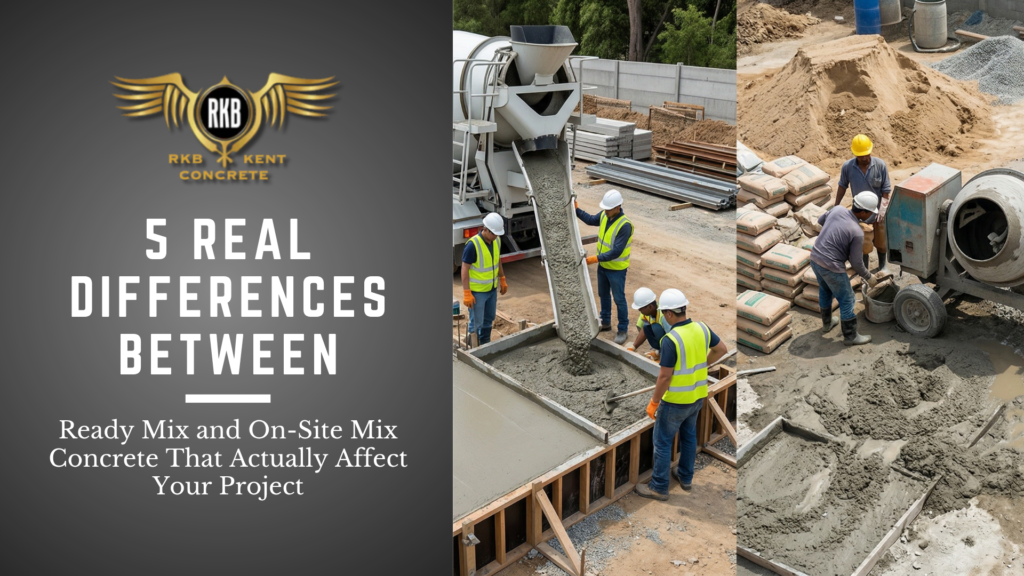
5 Real Differences Between Ready Mix and On-Site Mix Concrete That Actually Affect Your Project
1. Quality Control
Here’s something nobody tells you before they pour a foundation. The strength of your concrete doesn’t show up on the day. It shows up 28 days later, when the load is on, the walls are up, and it’s far too late to fix a weak pour.
Ready-mix concrete is batched to a specific grade with precision-controlled water-cement ratios. Every load is consistent. On-site hand mixing, as the study confirms, is influenced by operator skill, weather, fatigue, and minor measurement errors, all of which silently eat into compressive strength. Machine-based on-site mixing using volumetric trucks largely solves this, because materials are loaded separately and combined mechanically. But a poorly managed manual mix? That’s a risk that can haunt a structure for decades.
The bottom line: If your project needs a guaranteed, grade-specific concrete, C30 for a driveway, C40 for a structural slab, ready mix gives you that assurance.
2. Cost and Concrete Estimation
This is the pain point that catches most people out. You see the price of bags of cement, and you think: I’ll save a fortune doing this on site. And then the labour hours creep up. The mixer hire sits on the invoice. Half a bag goes solid in the rain. Someone miscalculates, and you’re short.
Accurate concrete estimation is actually what separates a smooth build from a chaotic one. The formula itself is simple: length × width × thickness = volume in cubic metres. But applying it correctly, accounting for wastage factors and depth inconsistencies in a real trench, is where things unravel.
With most trusted ready-mix concrete suppliers like us, what you order is what you use. Use our volumetric calculator before you call; it takes 60 seconds and gives you an exact figure. No guesswork. No leftover half-set loads that need disposing of. No panicked re-order at 3 pm because you miscalculated.
Volumetric on-site mixing takes this even further. You only pay for the concrete that’s actually poured. Not a litre more.
3. Waste: The Silent Budget Killer Nobody Budgets For
Let’s be honest. Concrete waste is one of those things that seems minor until it isn’t. A traditional drum truck delivering ready-mix concrete often comes with a minimum order. You order 3 cubic metres because that’s the minimum, use 2.4, and the rest ends up as a grey lump in someone’s garden.
Volumetric on-site concrete mixing removes this entirely. The components sit in separate compartments of the truck and combine on demand. You pour what you need. You stop. You pay for that exact amount, and for smaller domestic jobs across Kent, it’s often the smarter financial call.
4. Flexibility of Mix
A shed base and a suspended floor slab are not the same thing. A garden path and a crane beam are not the same thing. Using the wrong strength grade for the job is one of the most common and quietly expensive mistakes made on domestic builds.
Here’s a clear reference for what you’re likely to need:
Concrete Grade | Strength | Best Used For |
C20 | 20N | Single-storey foundations, shed & workshop bases |
C25 | 25N | Extensions, patios, trench fill, house floor blinding |
C30 | 30N | Driveways, paths, garage bases, conservatory slabs |
C40 | 40N | Structural & industrial applications, HGV parks |
C50 | 50N | High-rise, crane beams, commercial structures |
The advantage of on-site mix concrete is that the grade can be adjusted mid-job if conditions or requirements change. That kind of real-time flexibility is genuinely useful on complex or phased builds where the spec evolves as the groundwork reveals itself.
5. Speed and Delivery
Time pressure on a building site is relentless. A late concrete delivery doesn’t just mean you wait; it means your groundworker bills you for standing time. It means the next trade can’t follow on. It means the weather window closes and you’re scrambling to reschedule.
Therefore, we schedule delivery for ready mix concrete, same day, next day or even during nights, which is the fastest route from decision to pour. You call, it’s confirmed, it arrives. For large single pours, a full foundation, and a complete driveway slab, this speed is hard to beat.
On-site volumetric mixing is a different rhythm. It’s methodical. The truck arrives, sets up, and mixes continuously as required. For jobs that are phased or where access is limited and a full drum truck won’t fit easily, this approach is actually more practical and less disruptive.
Neither is universally better. They’re designed for different job profiles.
So Which One Actually Fits Your Project?
Genuinely, the answer changes with every build. But here’s a straightforward way to think about it: Go with ready-mix concrete if:
- You’re pouring a large volume in a single session, and speed matters
- You need a specific grade guaranteed for foundations, structural slabs, or commercial work
- You want the simplest possible process: one call, one delivery, one pour
Go with on-site mix concrete if:
- Your project is smaller, phased, or has variable volumes
- You want to pay only for what’s actually used with zero over-ordering
- Access to your site is tight, and a volumetric truck is easier to position than a full drum lorry
The worst decision is choosing purely on the headline price without accounting for waste, labour, delivery windows, and what happens if you under- or over-order. Get the full picture first. The maths usually shifts.
Conclusion
If you’ve read this far, you’re not just picking a product, you’re making a decision that affects how your build performs for the next 20, 30, 40 years. That’s worth getting right. And getting it right means working with a supplier who actually knows the difference between a C25 and a C30, understands your site conditions, and won’t just take your order and leave you to figure out the rest.
If you’re in Kent and searching for ready mix concrete suppliers near me, need onsite mix concrete near me, or want reliable concrete delivery in Ashford, RKB Kent Concrete Ltd. is who you call. Based in Gravesend, we supply premium-grade ready mix concrete and on-site volumetric mixes across Dartford, Ashford, Maidstone, Canterbury, Sittingbourne, and beyond. Whether you’re after ready mix concrete Gravesend, ready mix concrete Kent near me, or a bespoke on-site blend with no minimum waste, we offer same-day, next-day and even night delivery, a free volumetric calculator on our website, and a team who will talk you through the right grade for your exact job: no upselling, no confusion.
👉 Get a free quote or call us directly on +44 7956 409828. Your project deserves the right concrete, not just concrete that arrived.
FAQs
1. What is the main difference between ready mix and site mix concrete?
Ready mix concrete is produced at a plant to a precise strength grade and delivered ready to pour. Site-mixed concrete is made on your location using raw materials, offering flexibility on smaller or phased jobs, but requiring careful quality control to match the consistency of plant-batched concrete.
2. How do I work out how much concrete I need?
Its length × width × thickness, that gives you the volume in cubic metres. For anything beyond a straightforward slab, use our volumetric calculator before you order.
3. Is ready-mix concrete actually more expensive than site mix?
Not until you add up the full picture. Labour, equipment, material wastage, and the risk of an incorrect mix all carry costs. With volumetric on-site mixing, you only pay for what’s poured, which often makes it comparable to or better priced than traditional site mixing when done at any meaningful scale.
4. What concrete grade do I need for a driveway or house extension in Kent?
For driveways and paths, C30 (30N) is the standard. For extensions and house bases, C25 is widely specified. Always confirm with your supplier based on the groundwork, load expectations, and whether the area has clay or unstable subsoil, both common across parts of Kent.
Disclaimer- The information provided in the content is for educational purposes only and is written by a professional writer. Contact us to learn more about concrete supply.
Citation: