
Types of Concrete Pumps: Boom Pump vs Line Pump Explained
Table of Contents
Have you ever stood on site watching a mixer lorry idle at the gate – because concrete simply can’t reach the pour point? Time is ticking. Workers waiting. Costs climbing. According to research, the approach includes a set of structured activities and tools that are performed and applied for the identification and evaluation of the problems that produce construction waste, and the causes associated to them., inefficient concrete placement methods directly increase project timelines and waste labour hours on constrained sites. The pump you choose matters far more than most people realise.
That’s exactly why the types of concrete pumps deserve attention before you hire. There are two main options- boom pump and line pump. They look different, operate differently, and suit very different projects.The Superiority and Inferiority Ranking (SIR) method, a multicriteria decision-making technique, is proposed for facilitating the process of construction plant selection. confirms that correct pump selection significantly reduces wasted concrete and costly on-site delays. This blog breaks it down -clearly, plainly, no jargon.
Types of Concrete Pumps Every Builder Should Know Before Hiring
Concrete Pumping transports fresh and wet concrete to the exact location on site where it is required. It eliminates the strain of wheelbarrows, facilitates the pour and maintains constant consistency throughout the mix. From garden patios to large commercial structure foundations, we recommend using pumps on every project. There are two types: the boom pump and the line pump. Both are designed for very specific work; understanding the difference between them in advance can help you save time and money.
What Is a Boom Pump?
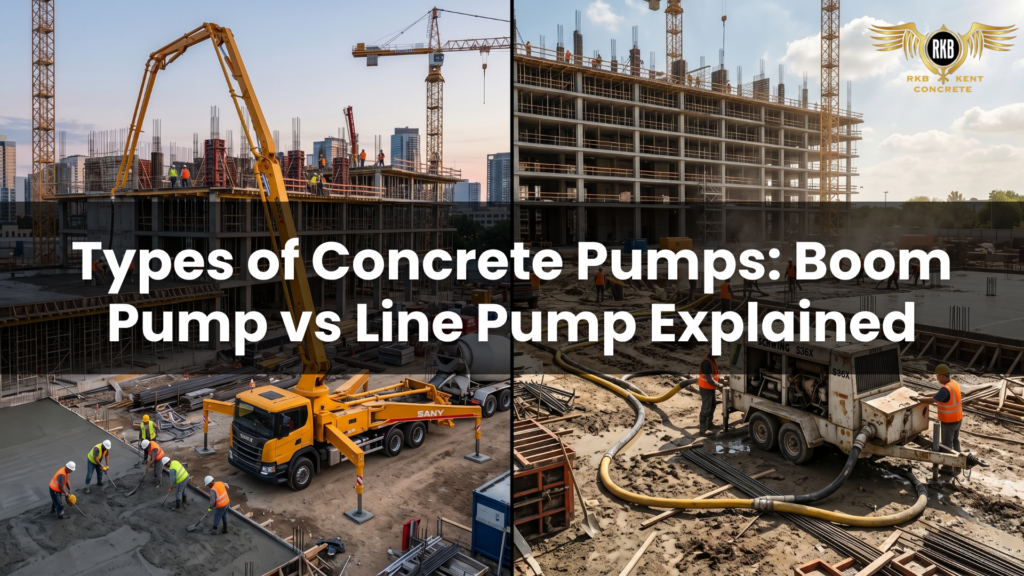
A boom pump is a truck-mounted pump with one long, remote-controlled, robotic arm or “boom” reaching across a site to place concrete – and as far up as it can reach – with accuracy from ground level all the way to the top.
Here’s what makes it so powerful:
- Telescoping reach: The boom extends from 17 to over 60 metres, clearing rooftops, elevated slabs, and walls with ease.
- Output speed: Boom pumps deliver 80 to 150 cubic metres of concrete per hour built for serious, high-volume pours.
- Remote-controlled operation: A single operator manages the arm via a handheld remote, cutting down ground crew requirements significantly.
- Multi-joint precision: The arm bends at multiple points, navigating obstacles and reaching tight pour positions accurately.
Think of it like a giant mechanical arm placing concrete with a surgeon’s precision. Large commercial builds, warehouse slabs, bridge decks, multi-storey frames — this is where boom pumps earn every penny of their hire cost. If your build is big, high, or wide-reaching, a boom pump handles it like nothing else.
What Is a Line Pump?
A line pump—also called a static or trailer pump — pushes concrete through a series of rigid steel pipes or flexible rubber hoses, all connected from the compact pump unit across the ground to the pour point.
Here’s what sets it apart on site:
- Compact footprint: The unit is small and trailer-mounted, fitting into tight spots a large truck simply can’t reach.
- Controlled output: Line pumps handle 15 to 50 cubic metres per hour — suited for smaller, precise, and controlled pours.
- Hose flexibility: Pipes and hoses run through doorways, over fences, and along narrow pathways without needing a large arm.
- Wider mix range: Line pumps handle thick mixes — screed, grout, and foamed concrete — that boom pumps typically can’t manage.
Picture this: pouring a rear extension slab on a tight terraced street. No room for a truck-mounted arm. A line pump unit sits on the pavement, a hose feeds over the fence, and the pour gets done cleanly. That’s exactly what a line pump is built for — the quiet, reliable workhorse of residential concrete.
Differences Between Boom Pump and Line Pump — Side by Side
Here’s the quick comparison that makes the decision easy:
Feature | Boom Pump | Line Pump |
Size | Large, truck-mounted | Compact, trailer-mounted |
Pour Rate | 80–150 m³/hour | 15–50 m³/hour |
Reach | Up to 60+ metres | Ground-level via pipes |
Best For | Large commercial pours | Residential, restricted sites |
Mix Types | Standard ready-mix | Standard + thick mixes |
Hire Cost | Higher | Lower |
The differences between the boom pump and the line pump go beyond size. Pour volume, site access, and mix type all shape the right choice. Getting this wrong on booking day is an avoidable problem that delays your job before it’s even started.
Which Is Better—Boom Pump or Line Pump?
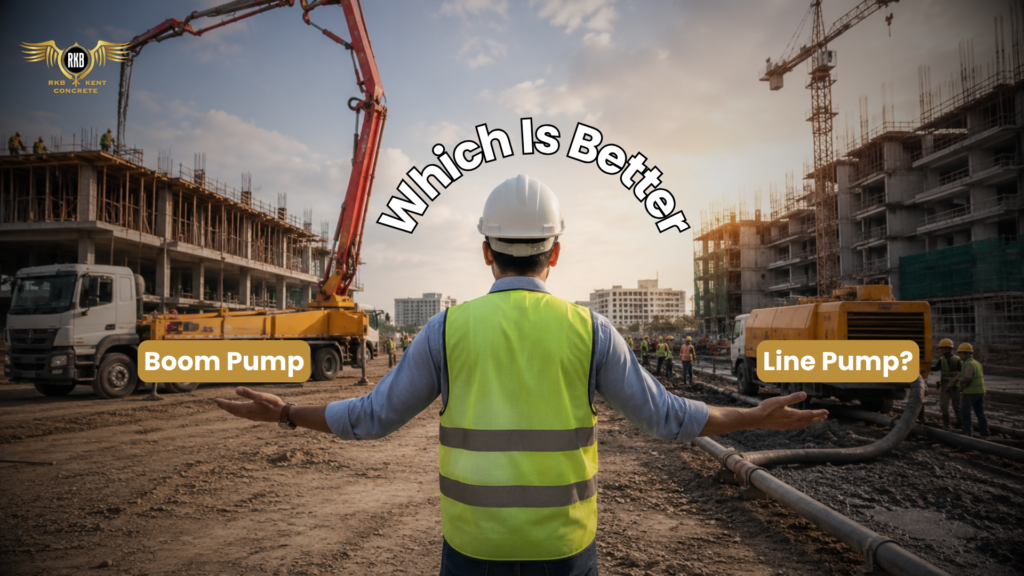
Neither is universally better. Each belongs to a different kind of job. The question isn’t “which is best?” — it’s “what does my site actually need?”
Choose a boom pump when:
- You’re pouring above ground level or across hard-to-reach areas
- Your project demands high output in a short time window
- You’re on a commercial build, large new-build, or structural foundation
Choose a line pump when:
- Site access is narrow or restricted — terraced houses, tight driveways, small plots
- Your pour is modest — a patio, garden extension, or ground-floor slab
- You’re pumping screed, grout, or a specialist thicker mix
Ask yourself one thing: can a large lorry comfortably reach the pour point? If yes, a boom pump is on the table. If access is tight, a line pump is almost certainly the smarter call. Still unsure? We’re here to help you work it out before you book.
Conclusion
Getting the types of concrete pumps right isn’t about technical jargon — it’s about one confident, practical call before the lorry arrives. Boom pumps deliver reach and volume for larger jobs. Line pumps bring flexibility and access for tighter, smaller pours. Both have a clear role in the right project. Know your site, know your mix, and the choice becomes obvious.
If you’re building in Gravesend, Dartford, Maidstone, or anywhere across Kent and the South East, RKB Kent Concrete Ltd. has the right pump for your project. We offer both types with same-day, next-day, and nighttime slots, competitive concrete pump hire costs, and expert 24*7 support from first call to final pour. Ring us up today and get your free quote, and let’s get your pour done right.
FAQs
How much does a concrete pump hire cost?
Hire cost depends on pump type, site location, and your project’s requirements. Boom pump hire runs higher than line pump hire due to the equipment scale. Always request a tailored quote — a blanket figure rarely reflects what your site actually needs.
- Can both pump types handle ready-mix concrete?
Yes. Both boom and line pumps work with standard ready-mix concrete. Line pumps also handle thicker mixes — screed, grout, and foamed concrete — that boom pumps typically don’t manage.
- How far can a line pump reach horizontally?
A line pump can typically reach 150 to 300 metres through connected pipes and hoses, depending on mix consistency and pump pressure on the day.
- Do I need a specific mix for concrete pumping?
Yes. Pumpable concrete must be fluid enough to move through pipes without blocking. Your concrete supplier should confirm the mix is pump-ready before delivery arrives on site.