
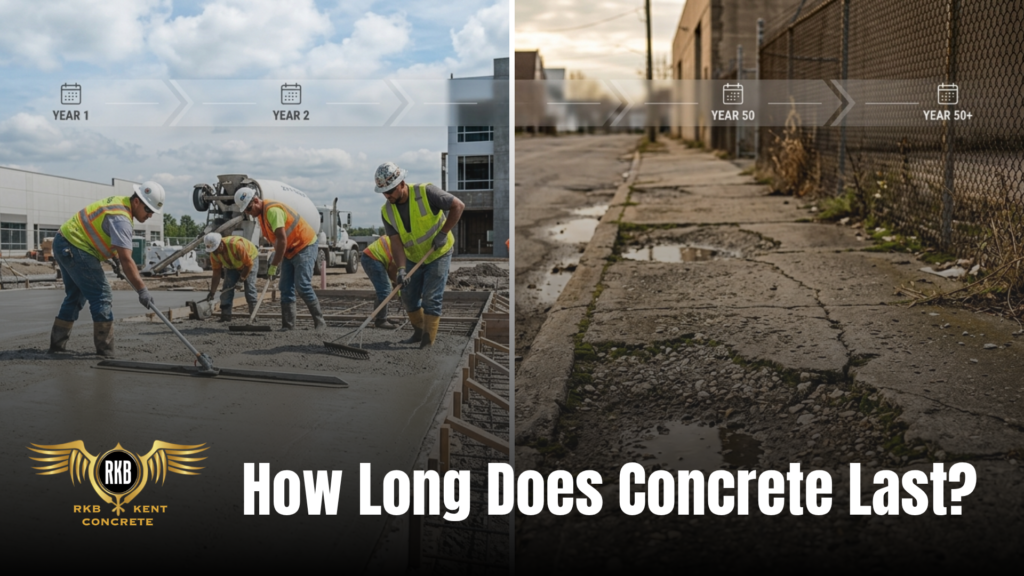
How Long Does Concrete Last?
Table of Contents
Have you ever looked at your driveway, money well spent, you thought and spotted cracks forming just a couple of winters later? That frustration hits harder when you realise it was preventable. You’re not just staring at cracked concrete. You’re looking at wasted money and a redo job nobody budgeted for. The question that deserved a proper answer long before any of this happened: how long does concrete last, and why does yours already look rough?
The importance of a foundation in a structure is a major consideration in the construction of any building, whether it is intended for residential, commercial, or industrial purposes. published through ResearchGate explains that properly designed concrete foundations can last for decades when strength and reinforcement are handled correctly. Another aspect of concrete durability is defined as the ability of concrete to resist physical and chemical attacks, which affects its longevity and performance, with key factors including permeability and susceptibility to issues such as sulfate attack, frost attack, and corrosion of metals. highlights how curing and environmental exposure affect concrete durability over time. The difference is made entirely in the decisions taken before the first pour.
How Long Does Concrete Last? The Real Numbers, by Use
Most people imagine concrete as something that simply endures. And in the right conditions, it genuinely does. But concrete durability depends entirely on what a structure was designed for — and whether the correct grade was chosen from the start. Here’s a realistic snapshot:
- Residential driveways and patios (C30): 25 to 50 years with proper care and sealing
- House foundations and structural slabs (C25–C40): 50 to 100+ years
- Garage floors and shed bases (C20–C30): 30 to 50 years
- Industrial and commercial floors (C40–C50): 50 to 100 years, depending on load
- Screed — internal flooring: 20 to 40 years, depending on foot traffic and moisture
These are realistic benchmarks, not guarantees. Concrete durability in practice depends on far more than grade alone. That’s exactly what we’re getting into next.
What Is the Lifespan of Concrete? It All Starts with Strength Grade
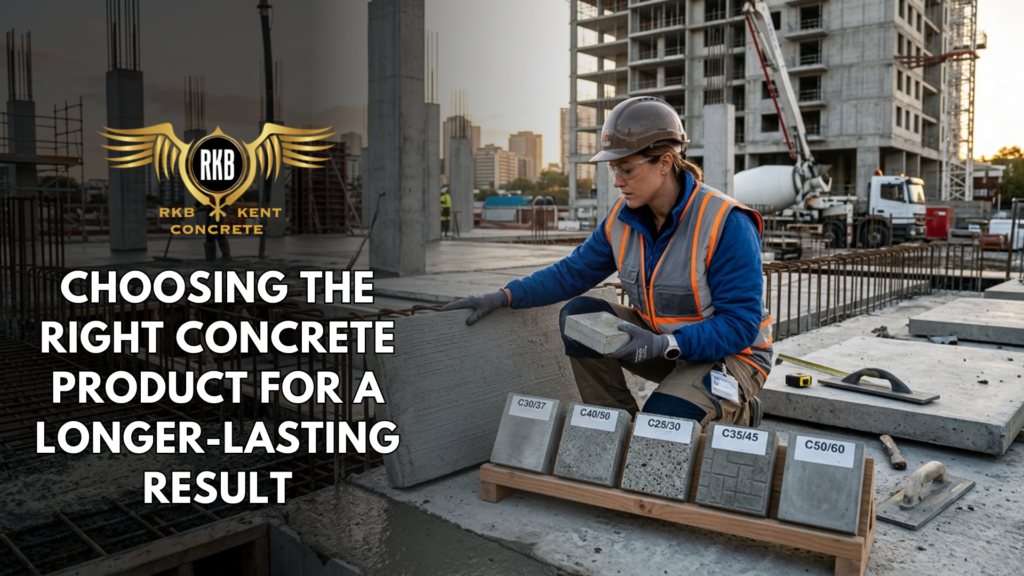
Not every mix is the same. Concrete is graded by compressive strength measured in newtons (N), and using the wrong grade is one of the most expensive mistakes we see on builds of all sizes. Here’s how each grade lines up:
- C20 (20N) — For single-storey foundations, internal floor slabs, garage floors, and shed bases. Reliable for lighter domestic loads.
- C25 (25N) — House extensions, pad foundations, drainage trenches, and mass concrete fill.
- C30 (30N) — The standard grade for driveways, footpaths, patios, and conservatory bases. Handles regular vehicle traffic and UK weather well.
- C40 (40N) — Structural and industrial work: HGV parks, agricultural stores, and heavy-duty floor slabs.
- C50 (50N) — Our strongest grade. High-rise buildings, crane beams, and motorway construction. Built to outlast everything around it.
Using a C20 mix on a driveway that carries daily car traffic is a bit like wearing plimsolls through a Kent winter; it’ll manage until it really doesn’t. Match the grade to the job every single time. That’s where concrete lifespan is genuinely won or lost.
5 Reasons Concrete Fails Before Its Time
Concrete doesn’t fail for no reason. There are specific, well-known causes and most happen before the concrete is even poured.
Wrong Strength Grade
Using a lower grade than the job demands is the fastest route to early failure. Concrete durability begins with the correct specification.
Too Much Water in the Mix
Extra water improves workability but weakens the internal structure significantly. It’s one of the most common and most damaging shortcuts taken on-site.
Poor Ground Preparation
An unstable or poorly compacted sub-base causes movement and cracking over time. The ground beneath the slab matters as much as the mix on top.
Rushing the Curing Process
Concrete needs a full 28 days to reach its rated strength. Loading it early, even with foot traffic, introduces stress fractures that worsen through every wet season.
Freeze-Thaw Damage
The UK’s wet winters are harder on concrete than most expect. Water enters surface pores, freezes, expands, and gradually breaks the slab apart. Correct specification and sealing prevent this entirely.
How to Make Concrete Last Longer — What Actually Works?
Most of the above failure causes are completely avoidable. Here’s what actually protects your investment over the long term:
- Specify the correct grade from day one — not the cheapest option available.
- Allow the full 28-day cure before applying any significant load.
- Seal exposed external surfaces, especially driveways and pathways, to block water ingress.
- Fix hairline cracks early — small cracks let water in, which accelerates damage through each winter season.
- Avoid de-icing salts directly on concrete surfaces — they break down the surface layer over repeated use.
The single most effective step is straightforward: use the right product, matched to the right application, from a supplier who understands the difference.
Choosing the Right Concrete Product for a Longer-Lasting Result
The grade is step one. The delivery and mixing method is step two. Here’s what’s available for domestic and commercial projects:
Ready Mix Concrete — Batched under controlled conditions using premium aggregate and cement. Available from C20 to C50. Consistent quality in every batch, delivered ready to pour. Same-day and next-day delivery available.
Volumetric Concrete — Mixed fresh on-site in exactly the right quantity. You pay only for what you use. No overordering, no waste, no unnecessary cost.
On-Site Mixed Concrete — Mixed directly at your location, from a few barrowfuls to a full commercial pour. Completely bespoke and eliminates the risk of the mix drying in transit.
Screed — A cement and sand blend laid over structural flooring to create a smooth, level finish. Available with or without fibre. Ideal for internal residential and commercial floors.
Concrete Pumps — For hard-to-reach areas or large pours. Faster, safer, and reduces the risk of the mix drying before placement.
All services are quoted individually, and we aim to beat any quotation with same-day or next-day delivery available across all product lines.
Conclusion
How long does concrete last? As long as the decisions behind it are sound ones. Choose the right grade. Pick the right product. Prepare the ground. Give it time to cure. Seal it where it counts. When those things come together, concrete doesn’t just endure for decades; it outlasts the structures around it, the seasons, and the trends. That’s simply what well-specified concrete does.
All homeowners and builders in Gravesend, Dartford and the whole of Kent get a better sense of security and less stress when it comes to using reliable building materials. RKB Kent Concrete is a ready, volumetric, on-site mixed concrete, screed and concrete pumping company for reliable performance. Get your free quote today at rkbkentconcrete.co.uk and build something that genuinely lasts.
FAQs
1. What is the lifespan of concrete in driveways?
Most concrete driveways last around thirty years or longer when properly installed and maintained.
2. Does weather affect concrete durability?
Yes. Rain, freezing temperatures, and heat can slowly weaken poorly protected concrete surfaces.
3. Can cracks reduce Concrete Lifespan?
Small cracks can grow quickly if water enters the slab, especially during cold weather.
4. Is ready-mix concrete better for long-term strength?
Professionally mixed concrete often creates more consistent strength and improved concrete durability.
Citations:
https://www.sciencedirect.com/topics/engineering/concrete-durability